Maggie O’Farrell’s Land and Me
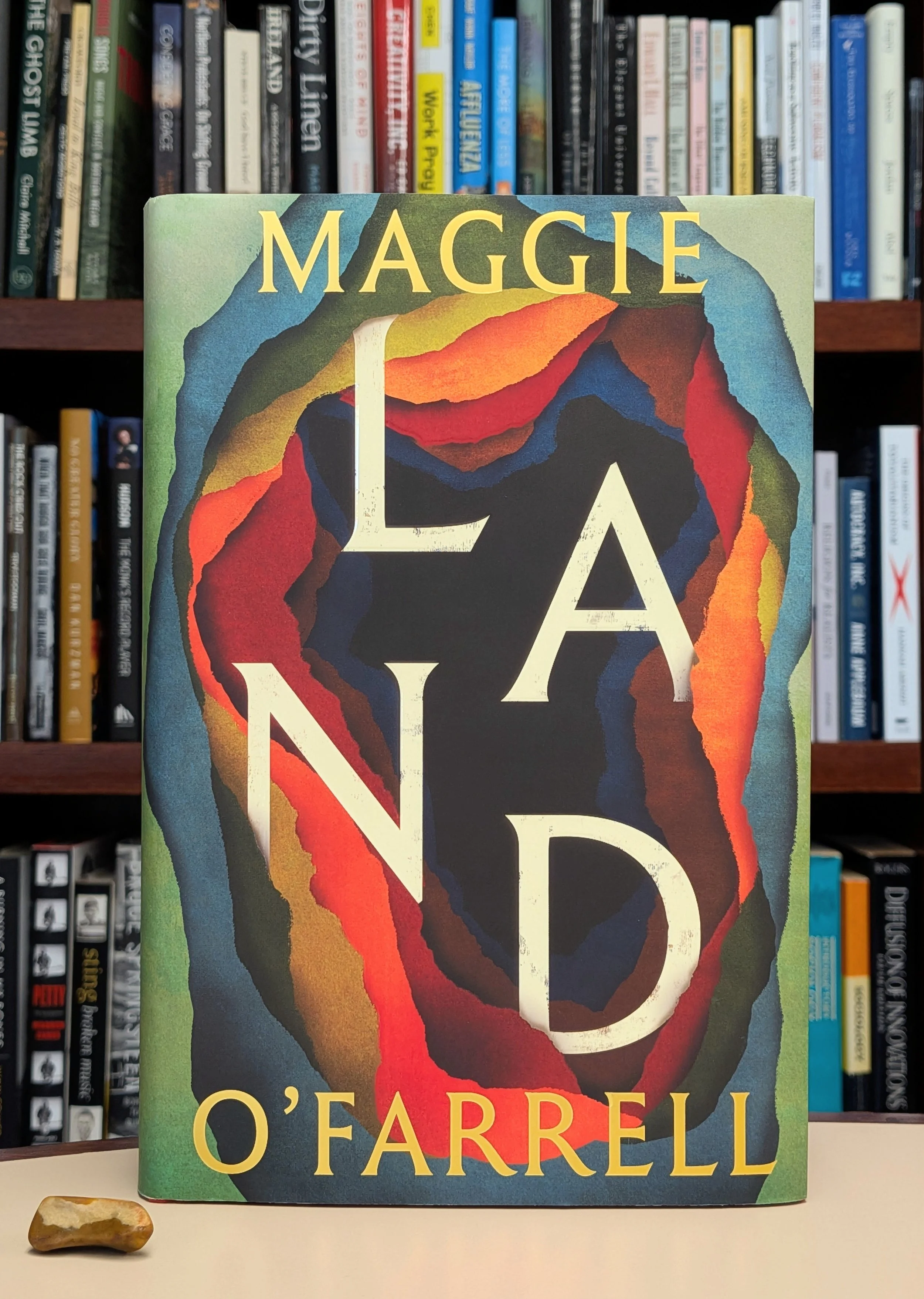
It wrecked me. Maggie O’Farrell’s Land left me in quite a state. Choosing it as my first book to read after returning to American soil after three weeks on my native land of Ireland may not have been my best decision.
The An Gorta Mór or The Great Hunger began five five generations ago when the Craigans were not Craigans or Presbyterians. The family lore is that during the great hunger we left the west of Ireland and moved to County Down, adopted a Protestant surname, abandoned Roman Catholicism, and became Presbyterians. All done in the quest to survive.
A people uprooted by starvation, deliberate starvation.
As I read the story of Tomás and his family I found myself identifying with aspects of both him and all his children, but what grabbed me the most was the connection to the land. The ancient land, the land where our ancestors had walked.
Tomás is a mapmaker for the British Ordnance Survey. The maps are used to define the land, which is one way of exercising control over the land. After entering a small copse and the holy well within it, Tomás has an epiphany, “I see it all now. I see that maps cannot be made with theodolites and poles and compasses alone. These are but playthings.” As he tries to explain it to his son Liam he continues, “My point is, my point is, my point is … there needs to be a map of how this land really is, of how it has always been, of what lies beneath whatever order or disorder others might impose upon it.”
Later in the book we find Tomás working on his new map and we’re told, “It was something he’d started years ago, a map of the thin places, the points of confluence between our world and other worlds, and some further baffling things … .” Those thin places where the space between the physical and spiritual is shrunk to little more than an arm's length. The land contains memories, impressions of life dating back millenia.
I’ve always felt that way. A deep connection to the land, to space. Not to all land and not all spaces. I surprised myself a few years ago when I visited Portnoo in Co. Donegal for the first time in 50 years. The land held me, I belonged. The same can be said of Belfast, Murlough Bay, the Giant’s Causeway, Portballintrae, the Mournes and some other spaces too. These are all places by the sea or ocean. I like how John O’Donohue explains the sea, “Unlike the land, which is fixed in one place, the sea manifests freedom: she is a primal dance, a dance that has always moved to its own music.” I need that music in my life, the older I get and the longer I live away from the sea I find I crave it more than ever. I resonate with O’Donohue’s experience of meeting the sea again after a time away, “Without knowing it, my body had been lonely for the sound, the sight and the effervescence of the ocean.”
It’s all too easy for us to dull our senses to the sacred nature of the world and the deep connection between humanity and the earth we walk upon - the earth we were formed from. “Then the Lord God formed man from the dust of the ground and breathed into his nostrils the breath of life, and the man became a living being” (Gen. 2:7).
There’s a wonderful moment at the end of Land when the events of the book move into the second half of the twentieth century, touching the edge of my own story. It felt like a call to connect with my history, who I am and where I came from.
I carry a stone, a piece of the land, in my pocket. I have carried it with me for many years.
I sit in my office, a heart, carved by a friend from Irish bog oak, some 5,000+ years old, sits with me.
Éire i mo chroí.